Your Score: 34. Your Competitor: 91. Guess Who Gets the Call.
When two HVAC sites show up for the same search, the one that looks more trustworthy in 5 seconds gets the call. Here's what makes the difference.
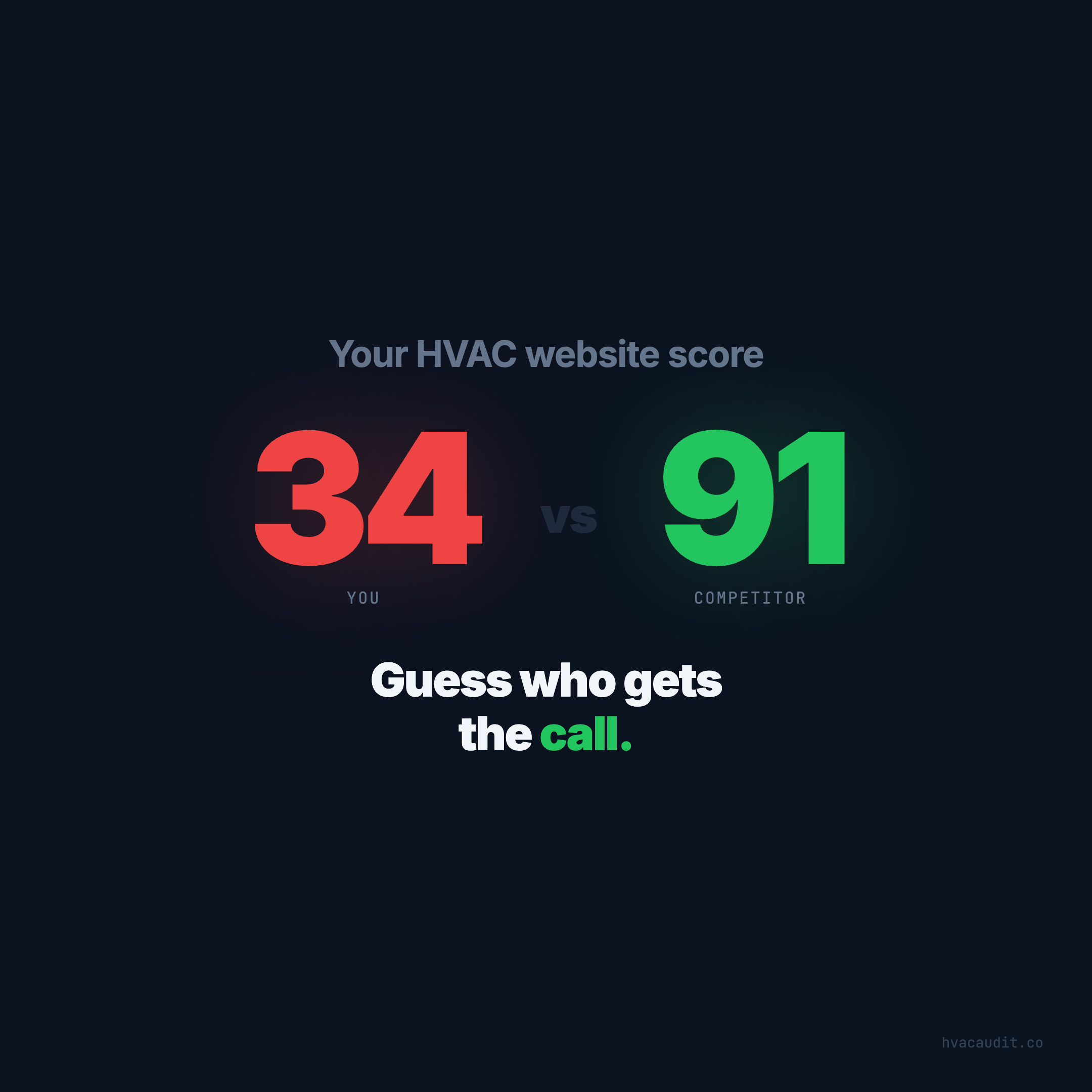
We scored two HVAC websites in the same city. Same zip code. Same services. Same price range.
One scored 34 out of 100. The other scored 91.
Guess who gets the call.
It’s not about who’s better at HVAC
Both companies had licensed technicians, good reviews, and years of experience. On paper, they’re equal.
But when a homeowner Googles “AC repair near me” and clicks both links, the decision is made in about 5 seconds. Not 5 minutes. Five seconds.
And in those 5 seconds, here’s what they see:
The 34-scoring site
- “Not Secure” warning in the browser bar
- Page still loading after 5 seconds
- When it finally loads: tiny text, no clear phone number
- Stock photos from 2015
- No reviews visible anywhere
The 91-scoring site
- Loads instantly
- Big “Call Now” button at the top
- “4.8 stars — 142 reviews” right on the homepage
- Real photos of the team and trucks
- “Book Online” button on every page
The homeowner doesn’t compare prices. They don’t read the About page. They call whoever looks trustworthy first.
The trust gap
Web users have been trained by Amazon, Google, and every major site to expect certain signals:
- HTTPS lock icon = safe to use
- Fast load = professional business
- Reviews visible = social proof
- Easy contact = they want my business
- Real photos = real company
When your site is missing these, it doesn’t just look outdated. It feels untrustworthy. Not consciously — nobody thinks “this site lacks SSL so I won’t call.” They just feel something’s off and hit the back button.
Your competitor’s site has all five signals. Yours has zero. That’s not a design problem. That’s a revenue problem.
Same traffic, different results
Here’s the part that hurts: both sites might get the same amount of traffic from Google. Same rankings. Same ad spend.
But the 91-site converts 3x more visitors into calls because people trust it enough to pick up the phone.
That means the 34-site is spending the same money on marketing and getting a third of the results. Every dollar of ad spend, every SEO effort, every Google Business listing — all underperforming because the website fumbles the handoff.
Closing the gap
Going from 34 to 91 isn’t a redesign. It’s a checklist:
- Add SSL — free, takes 30 minutes
- Fix speed — compress images, remove unused code, add caching
- Add click-to-call — sticky header with phone number, one afternoon
- Embed Google reviews — widget on the homepage, one hour
- Add after-hours contact — simple form or chat widget
Total time: a few days. Total cost: a fraction of what you’re losing.
The gap between 34 and 91 isn’t talent. It isn’t money. It’s attention. And right now, your competitor is getting the calls because they paid attention first.
Keep reading
- We Audited 147 HVAC Websites. The Average Score Was 34. — the full study behind the 34 average
- Your HVAC Website Is Losing You $4,200 Every Month — what that 34 score actually costs in dollars
- 18 Seconds. Your Customer Left After 3. — the speed problem explained
Want to know your score?
Drop your URL — full report in 48 hours.
We're on it.
Report in your inbox within 48 hours.